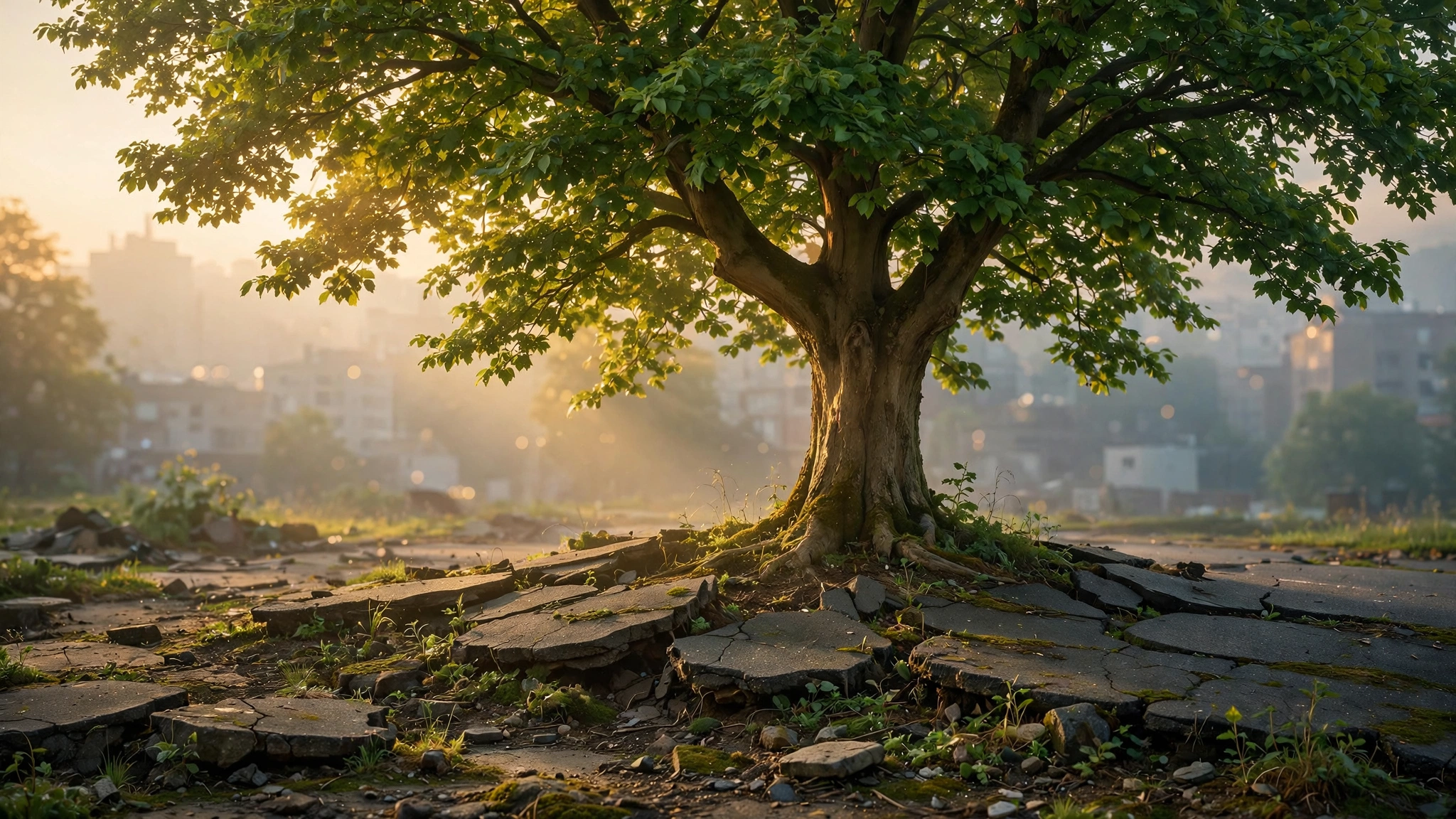
The Obvious Truth Nobody Checked
Cramped roots, polluted air, pavement that bakes in summer and salts in winter. Anyone who has watched a sapling strain against a parking lot median would bet that cities are no place for a tree. Asphalt and concrete absorb heat all day and radiate it back all night, creating a microclimate several degrees warmer than the countryside, and if you polled a hundred people on whether a tree grows better in a forest or on a city street, ninety-nine would pick the forest.
Nobody had systematically checked.
1,383 Trees, Ten Cities, Four Climate Zones
Hans Pretzsch, a forest growth scientist at the Technical University of Munich, assembled a team spanning eight countries and selected 1,383 mature trees across ten metropolises: Berlin, Brisbane, Cape Town, Hanoi, Houston, Munich, Paris, Prince George in Canada, Santiago de Chile, and Sapporo, with each city yielding samples from both urban sites and nearby rural forests. Species ranged from Sakhalin fir in northern Japan to African mahogany in South Africa, covering boreal, temperate, Mediterranean, and subtropical climate zones (Pretzsch et al., 2017).
The method was dendrochronology: counting and measuring tree rings to reconstruct growth year by year, sometimes back more than a century. Every continent told the same story. Urban trees grew 14 to 25 percent faster than rural trees of the same species and age.
At fifty, an urban tree had accumulated roughly a quarter more volume than its rural twin, and at a hundred the gap narrowed to around 20 percent but persisted. Ring data traced the divergence back to the 1960s, widening steadily since.
Why Concrete Beats Soil
Stop thinking of cities as hostile environments and start thinking of them as accidental greenhouses. Nighttime temperatures in urban heat islands run up to 10°C above the surrounding countryside, extending the growing season by weeks and giving trees more days to photosynthesize, while vehicle exhaust pumps extra CO₂ into the air and nitrogen from tailpipe emissions fertilizes soil that would otherwise be nutrient-poor. Street trees face almost no competition for sunlight because their canopies sit wide open, unshaded by the hundreds of neighbors that crowd a forest.
Warmth, carbon dioxide, nitrogen, light. Most crop scientists would recognize the combination as near-ideal growing conditions, and it happens to describe a downtown intersection.
Live Fast, Die Young
Two years later, a team at Boston University tested what Pretzsch's global snapshot could not measure: mortality. Ian Smith and colleagues tracked street trees and rural forest trees of the same species in the Boston area over nine years, recording both growth rates and death rates for red oaks and red maples on opposite sides of the city-forest boundary (Smith et al., 2019).
City trees grew four times faster. They also died at more than twice the rate.
When the team modeled lifetime carbon storage, faster-growing city trees stored less total carbon because they never survived long enough to reach the massive sizes that old-growth forest trees eventually achieve. Despite aggressive planting, Boston's street tree canopy was losing carbon over time because warmer nights raise respiration costs, droughts hit compacted soil harder, and root confinement eventually catches up with the trunk.
An Original Calculation
By 2050, 68 percent of the world's population will live in cities, according to the United Nations, and if urban tree mortality rates hold at double those of rural forests, cities face a demographic treadmill: they can replace trees fast enough to maintain canopy cover, but not fast enough to grow the old, massive specimens that store the most carbon per trunk.
Numbers make this concrete. By Pretzsch's growth curves, a city tree that lives to fifty stores approximately 1,200 kilograms of carbon, while a rural tree that lives to a hundred stores roughly 2,800 kilograms. Faster per year, but only 43 percent of the lifetime total. Doubling the planting rate does not fix this problem. It merely sustains a revolving population of smaller, younger trees.
The Strongest Case Against
Survivor bias is the most serious objection. Pretzsch's team sampled living trees, meaning those that died young from urban stress left no rings to count, and the surviving urban population may represent a hardier subset that would have grown fast in any environment. Rural trees face mortality too, but the selection pressures differ.
Pretzsch addresses this directly, noting that the acceleration holds uniformly across all ten climate zones and ten species, a consistency that selective survival alone cannot easily produce. The objection has not been formally ruled out, however, and the urban-rural comparison may overstate the causal effect of the city environment on any individual tree.
What We Didn't Prove
No one randomly assigned genetically identical trees to urban and rural sites and waited a century, so this remains observational data in which species and approximate age are controlled but dozens of confounding variables between a street in Houston and a forest outside Houston are not.
Boston tracked trees for nine years, not ninety, and mortality rates extrapolated from one decade in New England may not apply to tropical or arid cities where heat stress is more severe and water more scarce.
Neither study asks the question most relevant to city planners: can drought-tolerant species and adequate root space break the trade-off entirely? Every tree in these datasets was planted before anyone understood urban growth acceleration, let alone tried to manage it.
The Bottom Line
Urban trees grow faster than rural trees, up to 25 percent faster across ten global metropolises and potentially four times faster on American streets, because heat, CO₂, and nitrogen accidentally create growing conditions that outweigh compacted soil and pollution. But faster growth means faster aging, higher mortality, and less carbon stored over a tree's shortened lifetime.
What You Can Do
Rethink your city tree. It is probably growing faster than its forest counterpart, and it needs different care: deeper watering during drought and structural pruning to manage the rapid canopy expansion that concrete and exhaust fumes inadvertently fuel.
Advocate for root space, not just tree count. Municipal campaigns that pack saplings into tiny sidewalk grates optimize for short-term canopy rather than long-term carbon storage, and the single intervention most likely to extend urban tree lifespans is providing wider tree pits and structural soil beneath sidewalks so roots have room to grow.
Watch mature street trees for rapid decline. A city tree that grew fast for forty years can decline suddenly, and dead branches at the crown are the signal to call an arborist before a specimen that took decades to grow becomes a liability overnight.