The Prescription Every City Follows
Plant more trees. Green the rooftops. Expand the parks. Every city on Earth seems to have received the same memo, and the United Nations Sustainable Development Goals made it official policy: protect urban vegetation as a critical tool against rising temperatures. Hundred-billion-dollar greening programs from Dubai to Delhi operate on one shared assumption. Vegetation cools cities. A study of 761 megacities across 105 countries found that assumption fails for nearly a quarter of them.
The Global Paradox
Zhengfei Guo and a team spanning the University of Hong Kong, Western Sydney University, and the University of Bern analyzed high-resolution satellite temperature data and land-cover maps for every megacity on Earth. They measured the temperature difference between urban areas covered by vegetation and those covered by concrete, asphalt, and buildings. In tropical and temperate cities, the expected cooling held: urban trees lowered surface temperatures by an average of 5.24°C in tropical cities and 4.18°C in temperate ones compared to built-up surfaces.
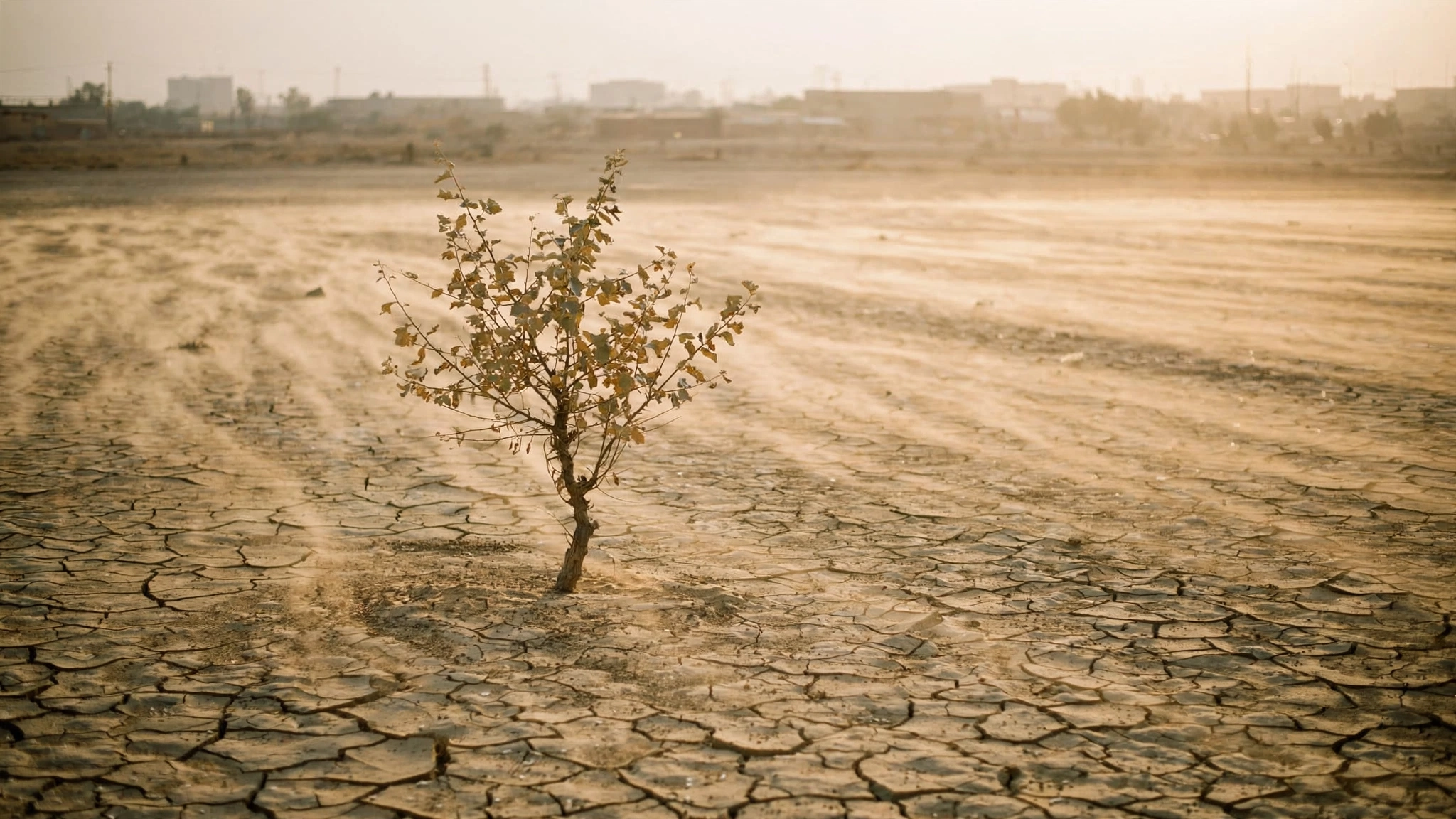
In arid cities, the picture inverted. Urban grasslands and croplands in 22% of all cities studied (164 cities with annual precipitation below roughly 1,000 millimeters) exhibited higher surface temperatures than bare concrete and asphalt. In 13 of the driest cities, even trees made things hotter. The average temperature difference between grassland and built-up areas in arid zones was +0.60°C. The vegetation added heat.
The mechanism is deceptively simple. Plants cool primarily through evapotranspiration: they pull water from the soil and release it as vapor, absorbing energy in the process. No water, no cooling. In arid cities, the soil is dry, and evapotranspiration slows to a trickle. What remains is the vegetation's dark surface, which absorbs more solar radiation than concrete or light-colored buildings. With too little water to convert that absorbed energy into cooling vapor, the greenery becomes a solar collector sitting on top of baked ground.
When Heatwaves Hit, Grass Gives Up
The study's most alarming finding concerns extreme heat events, defined as summer months with temperatures exceeding the 85th percentile of each city's historical record. Trees held up. They continued to cool 75% of cities during these events, reducing the temperature increase by an average of 0.49°C compared to built-up surfaces.
Grass did not. Grasslands exacerbated the temperature rise in 71% of cities during extreme heat, and croplands made things worse in 82%.
Why the split? Root depth. Trees can access soil moisture that persists well below the surface even during drought. Grasses and crops, with their shallow roots, lose access to water quickly. Under high atmospheric drought (vapor pressure deficit increased by 12.7% during heat extremes), grasslands reduced their canopy conductance by 15.5% while trees reduced theirs by only 10.5%. Trees maintained slight increases in evapotranspiration while grasses effectively shut down.
Run the numbers for an arid city that followed standard greening policy. If a municipality planted 100 hectares of irrigated grass in a desert climate and the grassland's warming effect averages +0.60°C relative to the built-up area it replaced, the city just created a heat source in the name of cooling. Multiply that across 164 megacities, each with populations exceeding one million, and the collective misdirection of urban cooling budgets becomes difficult to ignore.
The Strongest Case Against These Findings
The most credible challenge comes from the study's own limitations. The analysis relies on 100-meter-resolution satellite data, which captures neighborhood-scale averages but misses the micro-level cooling that individual trees provide at pedestrian height through shade. A mature tree shading a sidewalk reduces the felt temperature for someone walking beneath it regardless of what a satellite measures from orbit. The authors acknowledge that their surface temperature findings "cannot directly translate to pedestrian-level thermal comfort" and "do not negate the proven efficacy of well-placed shade trees."
A separate Nature Communications study led by Rob McDonald of the Nature Conservancy, also covering nearly 9,000 urban areas, found that tree canopy reduces the air-temperature urban heat island by an average of 0.15°C globally and that the greatest tree cooling efficiency occurs precisely in arid and semi-arid regions, provided water is available for irrigation. Phoenix, Arizona, maintains substantial tree cooling despite its desert climate because it irrigates its urban canopy. Benghazi, Libya, does not irrigate, and its trees warm the city. The warming paradox may not be an inherent property of arid-zone vegetation but a consequence of water investment.
What We Didn't Prove
The study is observational, not experimental: no cities were randomly assigned to plant or remove vegetation. The observed temperature differences could partially reflect confounding factors such as different building materials, urban geometry, or socioeconomic patterns that correlate with vegetation placement. The classification of vegetation into broad categories (trees, grassland, cropland) conceals meaningful variation between species. A drought-adapted mesquite provides different thermal regulation than an ornamental cypress, yet both fall under "trees." The analysis also relies on surface temperature rather than air temperature as its primary metric. While the two correlate (r > 0.68 across all three datasets), surface temperature exaggerates differences between land cover types compared to what a person at ground level would feel. The air-temperature analysis showed the same directional pattern but with much smaller magnitudes: trees cooled by 0.60°C rather than 3.71°C versus built-up areas. Whether the warming effect at the surface translates to meaningfully worse thermal comfort for residents requires street-level measurement that this study did not perform.
The Bottom Line
Urban greening is not the universal antidote to city heat that policy documents assume. In wet, tropical cities, planting trees remains one of the most effective cooling strategies available, lowering surface temperatures by more than 5°C relative to concrete. In dry cities receiving less than 1,000 millimeters of annual rainfall, the same strategy can backfire unless water is part of the commitment. The critical variable is not the vegetation itself but the water supply that powers its cooling. Without adequate water, greenery absorbs sunlight and warms.
What You Can Do
If you influence urban planning decisions, check your city's annual precipitation before adopting template greening policies from wetter climates. Cities below the 1,000-millimeter threshold should prioritize deep-rooted, drought-tolerant trees over grass-based landscaping: trees maintained cooling in 75% of cities during heatwaves while grasses failed in 71%. Where water infrastructure allows, irrigated tree canopies can sustain cooling even in desert climates, as Phoenix demonstrates. Where water is scarce, high-albedo alternatives (light-colored roofs, reflective pavements, shade structures) may deliver more cooling per dollar than unwatered greenery. For homeowners in dry climates, the study's findings distill to a simple rule: lose the lawn, keep the trees, lighten the ground. Replace decorative grass with tree canopy and reflective surfaces, because in an arid city the grass is not cooling your neighborhood. It is quietly making it hotter.